

- Parent Guides
My Child Loves Stories, But Hates Being Picked; Could Drama Still Work for Them?
A child can love stories and imagination but still dislike being watched. Discover how drama can offer gentler ways to watch, join in and build confidence.
That is often the worry with drama. It is not that your child has no imagination. It is that drama can sound as if someone will ask them to stand up, speak loudly, remember a line, or be looked at before they have worked out who the teacher is, what the room feels like, and whether the other children are the sort of children who will laugh if something goes wrong.
A good class should not make that the starting point.
In a Drama Kids class, a child can start with something much smaller than being singled out. They might sit with the group while the register is taken. They might copy a movement, join a sound everyone is making together, or answer through a character rather than as themselves. They might speak first to one other child, or take part in a group moment where no one child is being watched on their own.
That is still drama. It is just not the version many parents picture when they worry their child will be put on the spot.
Some children need a few minutes before joining in
Some children need a little time before they are ready to take part. They may stand close to you at first, watching where the other children sit, how the teacher speaks to them, whether the room feels noisy, and whether everyone else seems to know what to do. If they hang back, it does not always mean they dislike the class. Sometimes they are simply working out what is happening before they feel ready to join in.
This can be difficult to judge from the doorway. You may see a child who is not saying much. A teacher may see a child who is following the game with their eyes, copying a movement when they think nobody is looking, smiling when something funny happens, or moving slightly nearer to the group once the first few minutes have passed.
Those are not dramatic signs, but they matter. They tell the teacher that the child is not switched off. They are watching, noticing, and working out how much they are ready to try.
A child may not talk about any of this when they come out. They may shrug when you ask how it went, then later repeat a funny sound from class or mention another child while they are brushing their teeth. For some children, that is normal. They need to get through the new experience first, and only talk about it once they are back somewhere familiar.
The worry is not always drama; it is being picked too soon
Many children who seem quiet in a class are not quiet everywhere.
They may speak easily with family, make siblings follow their game rules, or tell a story in the car that takes three attempts to finish. The problem starts when they feel several people turn towards them at once. Their body goes still. Their voice drops. The sentence they had in their head disappears because now everyone is waiting.
That is why the first steps in a drama class matter so much.
A child who would hate being asked to speak alone may be able to speak when the whole group is making the sound together. A child who freezes when asked an open question may manage a choice between two character feelings. A child who does not want to participate in a scene may still stand in a group picture, hold a position, copy an action, or whisper an idea to a partner.
The teacher is not looking for every child to begin in the same way. One child may come in through voice. Another may come in through movement. Another may need a partner beside them. Another may watch the first activity and join the next one once they have seen how it works.
For a child who hates being picked, that difference is important. They are not being pushed straight from silence into participation. They are being given a way to try something without feeling trapped by everyone’s attention.
A familiar class rhythm can make the room less overwhelming
A Drama Kids lesson is not meant to feel like a room where children are simply told to get up and join in however they can. The class has a shape. There is a beginning, a register, introductory activities, voice work, movement, main drama work and a closing moment, although the exact activities will change depending on the age group, the term and the lesson.
For a child who finds new places difficult, that pattern can help. After a few weeks, they begin to know what usually happens when they arrive. They know where the group sits. They know that the teacher will explain the next activity. They know that the first thing they are asked to do is not usually the biggest thing.
This does not mean the class becomes predictable in a boring way. The stories, characters and situations may change every week, and the children still have to use their imagination. But the child is not walking into a blank space where anything could be demanded of them at any moment. There is enough routine for them to feel less lost, and enough play for them to want to take part.
Ways a child may begin joining in
Watching first
Following the game, noticing the teacher and learning how the room works.
Working with a partner
Whispering an idea, making a choice or trying a line with one other child.
Joining with the group
Copying a movement or adding their voice to a shared sound.
Using a character
Speaking through a role so the attention feels less direct.
Joining in can begin with the group
If your child worries about being watched, group work can be the easiest place to begin.
They may move with everyone else in a warm-up. They may help make the sound of footsteps, rain, animals, a crowd, a machine, or a door opening. They may repeat a phrase with the class so their own voice is part of the whole sound. They may help create a scene where several children are trees, shopkeepers, explorers, passengers, animals or people in a busy street.
From the outside, this can look like simple play, but there is a lot happening inside it. The child is listening for the teacher’s cue, watching the other children, using their voice or body at the right time, and staying with the activity long enough to be part of the shared idea.
Over time, the teacher can make the step a little bigger. The child who copied a movement may be invited to choose one. The child who joined a group sound may try the sound with a partner. The child who pointed to an answer may start saying the word. The child who whispered an idea may hear that idea used in the story.
That moment can mean a great deal to a quieter child. Something they thought of has entered the room, and nothing bad has happened. The group has carried on, kindly, with their idea inside it.
Speaking as a character can feel easier than speaking as themselves
Some children find it easier to speak when the words belong to a character.
They may not want to say, “I am scared,” in front of a class, but they may be able to say that the lost explorer is scared because they cannot find the path home. They may not want to explain their own idea, but they can tell the teacher what the dragon is guarding, why the shopkeeper is cross, or what the detective has just noticed.
The character gives them a little distance. The attention is not sitting quite so directly on them.
This is one of the reasons voice work in drama is not only about being louder. A child might try a line as a secret, a warning, a question, an apology, an announcement, or a message to someone across the room. They may practise changing the voice because the character is worried, excited, bossy, tired, proud or trying very hard not to laugh.
The child is still working on communication. They are learning to make the words clear enough for someone else to understand, but the reason for speaking comes from the story. They are not being told to “speak up” for the sake of it. They are trying to make another character hear them, believe them, follow them, or answer them.
For a child who becomes quiet under direct attention, that can make the task feel much less exposed.
Some children need to move before they can explain
Not every child begins with words.
A child may not want to explain that a character is nervous, but they can show it in the way they walk, stand, turn their head or hold their hands. They may not want to describe a storm, but they can become part of one with the group. They may not want to answer a question about what a character is feeling, but they can show a giant walking into a tiny room, a mouse trying not to be seen, or a teacher who has had a very long day.
The movement is often what helps them work out what they mean.
Once the child has shown the character with their body, they have already made decisions. Is the character hiding? Are they angry? Are they trying to be brave? Are they looking for something? When the teacher later asks what the character is thinking, the child has something to use. They are not pulling an answer from nowhere; they have already played part of it.
For children who freeze when asked a question, this can be a kinder way into speaking. The idea begins with the body, and the words come afterwards.
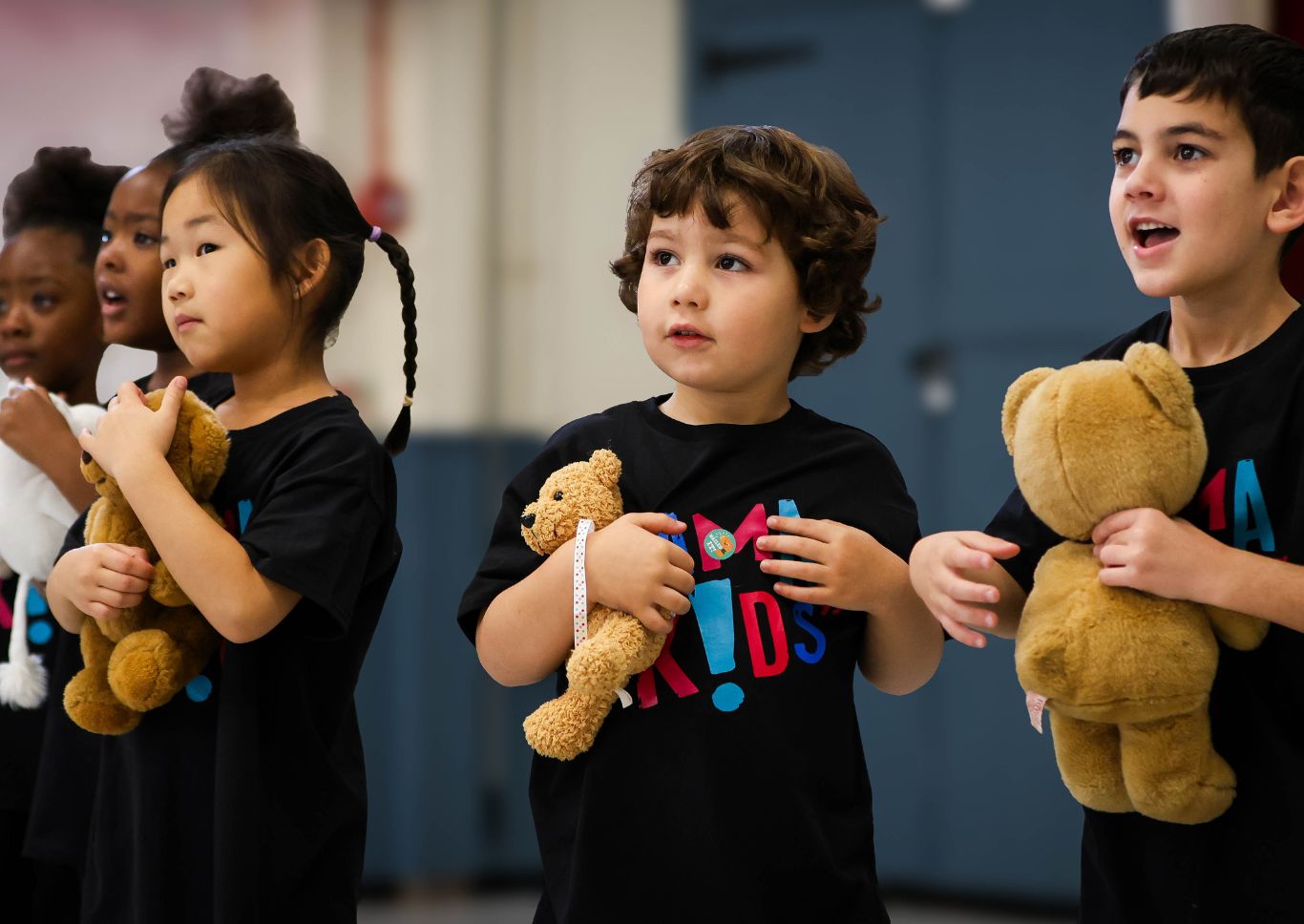
The teacher should notice more than the child who speaks first
In any children’s class, there will usually be someone who answers quickly, someone who wants the biggest part, and someone who is ready before the instructions are finished. Those children are easy to notice.
A good teacher also notices the child who is almost ready.
They may notice that a child answers better when they are given a choice instead of a wide-open question. They may see that the child is more comfortable next to one particular partner. They may realise that the child will join movement before voice, or group sound before a solo line. They may notice that a child is following everything but needs more time before they are asked to contribute.
That kind of attention changes what the teacher offers next.
Instead of asking the child to participate alone, the teacher might ask them to help make a group sound. Instead of asking them to explain a whole idea, the teacher might let them choose between two options. Instead of asking them to speak to the whole class, the teacher might ask them to decide something with a partner first.
The challenge is still there, but it is the right size. The child is not being left alone with a task they cannot yet manage. They are being given a first step that makes the second step more likely.
Encouragement should not feel like being forced
There is a difference between encouraging a child and pushing them past what they can manage.
A teacher can still ask for more. They can ask for a clearer voice, a stronger movement, another try, or a braver choice. Children do need gentle stretching, otherwise they never discover what they can do. But the stretch has to make sense for the child in front of them.
For one child, the stretch may be saying a line so the group can hear it. For another, it may be staying in the circle for the whole warm-up. For another, it may be letting a partner share their idea. For another, it may be joining again after stepping out of an activity.
These are small things only if you are not the child doing them.
For a child who usually shuts down in unfamiliar groups, staying in the room, copying the movement, trying the sound, or coming back the next week may already be a real step. The confidence comes from repeating those steps and finding that the class remains a safe place to try.
What you might notice after a few weeks
The first changes may be easy to miss.
Your child may walk in with less hesitation. They may stop asking quite so many questions on the way there. They may remember where to sit. They may tell you the teacher’s name. They may mention another child, repeat a funny voice, or show you how a character moved.
You may also notice small changes outside class. They may answer with a little more detail when someone asks what they did at the weekend. They may use a clearer voice when speaking to a relative or asking for something in a shop. They may recover faster when they muddle a sentence. Their schoolteacher may mention that they joined group work more readily, took part in assembly practice, or seemed more comfortable with children outside their usual circle.
It will not always look like a sudden burst of confidence. For many children, the first change is simply that there is less resistance. The class is no longer unknown. The teacher is no longer a stranger. There is a game they remember, a child they recognise, a part of the room they understand, or a moment they know they can manage.
That familiarity can be what lets the next step happen.
Walking in with less hesitation
Mentioning the teacher or another child
Remembering where to sit
Repeating a funny voice or movement at home
BEFORE THE FIRST CLASS
What to tell the studio before a trial
If you are unsure whether drama will suit your child, speak to your local studio before the first class.
You do not need to apologise for your child or make their personality sound like a problem. It is enough to explain what usually happens in new situations. You might say that they talk at home but freeze in groups. You might say they love stories but hate being picked. You might say they need to watch before joining in, or that they become upset if they feel rushed.
It is fair to ask how new children are welcomed, whether children must participate straight away, whether the class uses partner and group work, and what the teacher does if a child needs a little time before taking part.
It also helps to tell the teacher what your child already enjoys. Animals, football, superheroes, jokes, dancing, drawing, music, strange voices, make-believe, building things, stories about school, stories about monsters, stories about anything at all — these can all give the teacher something to work with.
The easiest starting point is often not a general promise of confidence. It may be a character, a sound, a movement, a joke, a partner task, or a story that gives the child a reason to step in.
Could drama still be right for them?
Drama may suit your child if they enjoy imagination, stories, characters, movement, sound or make-believe, but find direct attention difficult.
They do not need to arrive already confident. They do not need to love being watched. They do not need to be the child who volunteers first.
What they need is a class where the teacher understands that children do not all begin in the same place. Some will speak early. Some will move first. Some will watch before they join. Some will need a partner. Some will find it easier to speak as a character before they speak as themselves.
A child who hates being put on the spot may still enjoy drama when the class gives them time to understand what is happening and enough different ways to take part. They can use their voice, body, imagination and ideas without having to become suddenly bold at the door.
For some children, that is exactly why drama helps. It does not ask them to stop being careful, observant or slow to warm up. It gives them somewhere to practise joining in, one manageable step at a time.
The useful question is not whether your child is naturally confident enough for drama. It is whether the class gives them a way to join in before they feel ready for direct attention. For some children, that starts with a group sound, a partner activity, a character, or simply knowing what happens when they walk into the room.
Taking the next step
A trial class can be useful because it gives your child a chance to meet the teacher, see how the class works, and try joining in without everything needing to be decided on the first day.
Before they arrive, it helps to tell your local studio what usually happens in new groups. They do not need a long explanation. Just knowing that your child watches first, dislikes being picked, or finds it easier to speak once they know someone gives the teacher a better starting point.
For some children, the first sign is small. They remember a game. They mention another child. They walk in with a little less hesitation the next time. That can be enough of a beginning.
Find your nearest Drama Kids class and speak to your local studio about whether a trial would suit your child.
Find a Drama Kids class near you
Speak to your local Drama Kids studio about how your child responds to new groups and whether a trial would suit them.
Questions parents often ask
Can my child try a class if they usually watch first?
Yes. Some children need to see how a class works before they are ready to join in fully. It helps to tell your local studio before the trial, so the teacher knows your child may need a little time before taking part.
Will my child have to speak on their own straight away?
Not every child begins by speaking alone. In a Drama Kids class, children may first use their voice with the group, work with a partner, answer through a character, or take part through movement before they are ready for more direct speaking.
What should I tell the teacher before the first class?
Tell them what usually happens in new groups. For example, your child may talk freely at home but go quiet elsewhere, dislike being picked, need to watch first, or find it easier to speak once they know one other child. It also helps to mention what your child enjoys, such as stories, animals, superheroes, music, jokes, drawing or make-believe.
What if my child says very little after the class?
That does not always mean the class went badly. Some children need time before they talk about a new experience. They may mention a game later, repeat a sound at home, remember another child’s name, or feel a little less unsure the next time they arrive.
How do I know which class is right for my child?
Your local studio can help you choose the right class for your child’s age and stage. It is worth explaining whether your child is cautious in new groups, enjoys imaginative play, likes movement or stories, or needs a gentler first step into joining in. That gives the studio a clearer picture before the trial.


